A tractor never seems to have a breakdown at a good time. What often happens is that the problem begins at the moment when every hour in the field is critical. A worn clutch plate, hydraulic seal leakage, or crown pinion breakage can turn a hit and miss harvest day into a costly delay. For this reason, your tractor maintenance checklist should have a steady place in your farming regime, not be something that is called upon during emergency repair. Pre and post-harvest checks can highlight unseen damage, safeguard critical components and ensure uptime where it counts.
Mechanical “surprises” will be much less if the busy season is used prior to going to seed for a general inspection of each tractor's major systems.
Think of preventive maintenance as maintaining an athlete before the championship. Small improvements today can avoid serious errors down the road.
Follow this farm tractor maintenance schedule before heading into the fields:
Many countries' growers felt that early checks were very valuable in preventing emergency repairs to the haulm. A minor defect may show up as an indication of a majorproblems1 at the peak of the harvest.
Agricultural Machinery Predictive Maintenance. Such a process also accelerates agricultural machinery preventive maintenance, reducing the chances that the machine use endure for long hours during operation, putting other parts of the apparatus under unnecessary strain.
Hydraulics and transmission systems shoulder a large portion of a tractor's day-to-day work. Neglect in these areas can result in increased wear and failure... at a price.
Check the tractor hydraulic and transmission parts and the hydraulic fluid. If the hydraulic fluid is low or dirty it will hinder the lift and steering.
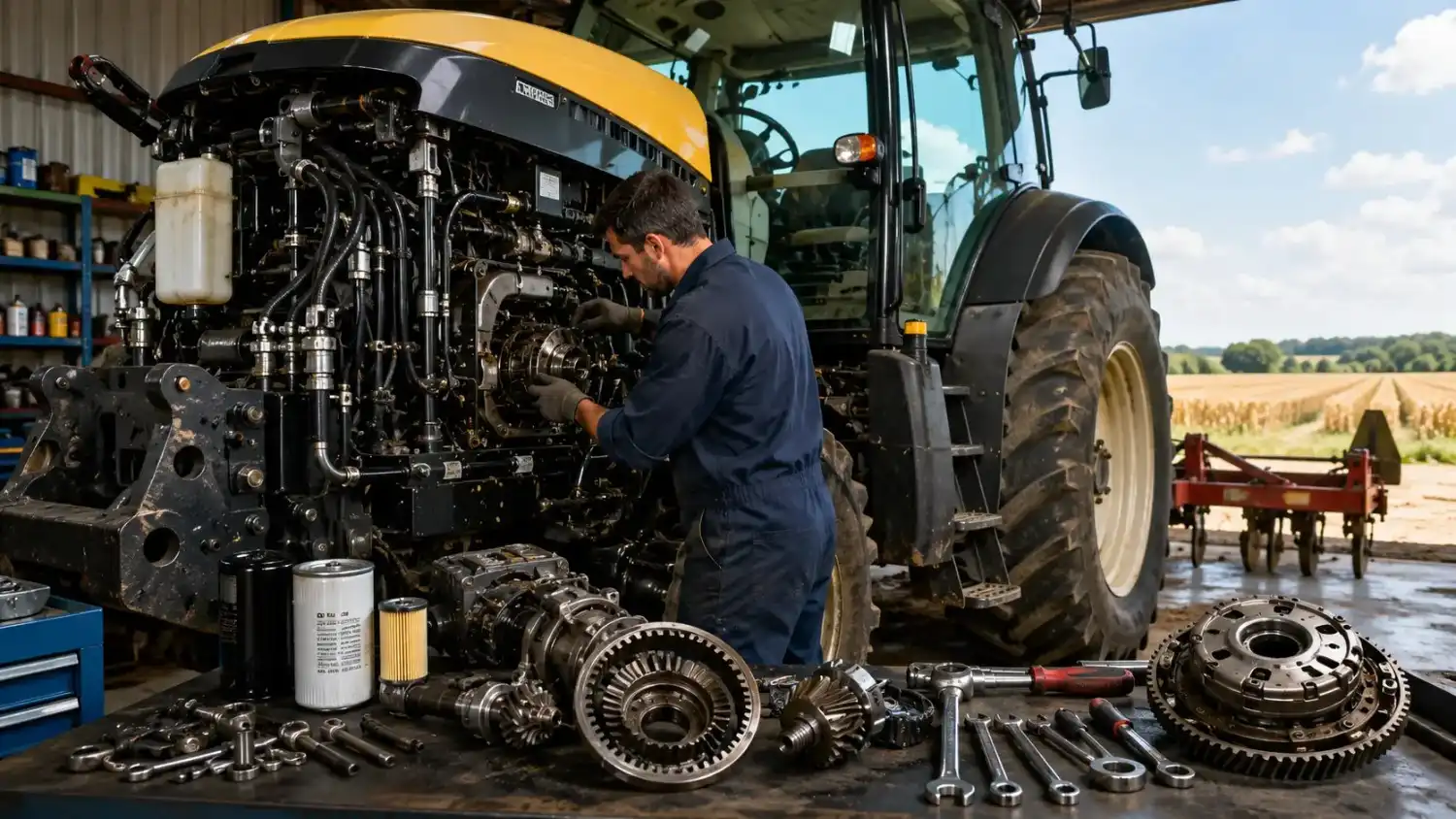
Next, inspect:
Internal wear may already be present if the gears seem noisy or if shifting becomes a problem.
Frequent field operation causes constant stress on gears, bearings and shafts. Small metal particles in transmission oil are the first indicator of damage.
A good tractor parts spare guide for replacement will suggest when to change seals, oils and filters before they break down. The cost of a genuine service is as little as 70% less than the cost of rebuilding a transmission.
Trivia: A few tiny metal particles in transmission oil can be one of the earliest warning signs of internal gear wear.
Clutches and Brake systems have a direct impact on the safety and productivity of the enterprise; this significantly worsens with the loads of harvest, when the tractors work the most.
The basics of checking the tractor clutch and brake plates consist of simple visual inspection.
Watch for these warning signs:
A significant number of learners find that clutch plates wear progressively. The driver will adapt to the conditions until damage is significant.
Likewise, brake linings should be given greater consideration. The thinner the brake lining is the greater the impact on brake efficiency and safety on varied farmlands, especially in uneven farmlands.
Changing the clutch and brake plates over before harvest is a good way of protecting the surrounding parts and ensuring that the tractor remains in good working condition during long working days.
Fun Fact: Regular pre- and post-harvest tractor maintenance can help prevent costly breakdowns and extend your tractor's lifespan.
The diff locks quietly take huge amounts of mechanical abuse. Though obscured within the axle housing, its state has a significant effect on the dependability of the tractor.
For tractor crown pinions and differentials, Sir. First, listen for all after working.
Warning sounds include:
This usually indicates an excessively worn gear or a defective bearing.
Then, before answering, check the differential oil. When dark oil is found with traces of metal, it is a strong indicator of ongoing internal wear.
Crown wheels and pinions are subject to high loads in harsh operation. Overloaded tractors or insufficient lubrication can significantly accelerate wear.
Neglecting to address these issues could ultimately lead to the axle assembly getting damaged as a whole.
Timely replacement of worn gears is frequently a lot cheaper than repairing a failed differential. Early preventive inspection allows farm machinery downtime to be avoided and provides for peak use of priceless equipment when field conditions dictate unbroken work.
Most owners park most of their tractors after harvest for either the whole winter (over a year) or part of it. The trouble with this is that hidden damage remains inside the machine during this period of storage.
The end-of-season maintenance allows the equipment to be prepared for next year's farming system.
Focus on these maintenance tasks:
This step also provides a way of revealing some of the heavy-duty wear and tear of the tractor over several months of full-time work.
Most experts believe that putting damaged parts in a box right away can prevent the corrosion from continuing to spread during storage.
Likewise, quality of storage areas can help prolong the life of some tractor components. All electrical systems, rubber parts and exposed metal surfaces are susceptible to damage by water, dirt or rats.
A single inspection annually is seldom effective. Continuous maintenance during the growing season produces more sustainable benefits.
A popular and successful schedule to follow is one that incorporates daily Checks, weekly Inspections, seasonal Servicing, and predetermined Replacement of spare parts.
A simple schedule may include:
This structured way strengthens the maintenance of agricultural spare parts to reduce random failures.
Weather conditions also impact operation. Dust, moisture, heavy pulling, and rough ground all put more mechanical load on the tractor. When working the tractor in such conditions, more frequent checks are necessary than with light-use operation.
It also makes it easier to keep maintenance records. Writing down the replacement dates for the filters, clutch plates, hydraulic seals and bearings anticipates future maintenance and can even help forecast future repairs.
The key point is that not all parts need to be replaced in order to provide a satisfactory level of maintenance. It is about replacing the right component at the right time.
Blackbird Gears has been in this business since 1987 and in over three decades, we have seen a lot change in the agricultural and earthmoving industry. Blackbird Founded by Vimal Ray Chadha at Wazirpur Industrial Area, Delhi, we started as a local spare parts supplier and grew, order by order and relationship by relationship, into a manufacturer and exporter however, today we serve customers across 29+ countries. We started from a small setup in Delhi to exhibiting at international trade shows across four continents the journey has been built on one thing: the trust of farmers, distributors, and equipment businesses who needed a supplier they could count on. That trust did not come easy, and we do not take it for granted. Our story started with a straightforward idea that every farmer and every equipment operator, no matter where they are, deserves access to good-quality spare parts without being overcharged for them. That idea still sits at the centre of everything we do, 37 years later.
Success upon the harvest is a lot more than crops and the weather. Equipment must be dependable; otherwise, you risk the difference between production finishing and expensive delays occurring. Your tractor can become more dependable with a consult from the complete maintenance checklist, seasonal maintenance inspections, and by finishing wear-out spare parts before failure will maximize tractor efficiency. Keep hydraulic systems, transmission parts, clutch plates, brake kits, crown pinions and differentials in good working order on a constant basis and carry out reconditioning when required. This reduces maintenance costs and enhances reliability to a maximum extent. Use each check as a strategic step toward reducing farm machinery downtime and preparing your tractor to win the next high pressure season.
|
Contact US Blackbird Gears Now for Premium Quality Products! |
Maintains good operating condition, prevents breakdowns, enhances efficiency, and eliminates idle time of the tractor.
Test or inspect the hydraulic components, transmission parts, check the clutch and brake plates, filters, belts, bearing and ring gear of the differential.
Follow a planned routine of maintenance with checks on a daily basis and overhauls of regular maintenance and thorough inspections pre- and post-harvest.
The symptoms you may notice are clutch slippage, a lack of braking power, strange noises or when you get ‘locked’ when trying to shift up or down.
Prevents breakdowns, protects equipment and extends the life of components; minimizes costly downtime.
It also finds increased use for pre-season storage. The tractor is protected from corrosion during this time and is checked for any wear.