The tractor has passed the halfway point in a field and a gear gives out. A fix is needed now. So, you pick up a piece which is just like the old piece. Then it doesn't fit. Sound familiar? We've all done it! When selecting the appropriate Tractor Spare Parts, knowledge of fitment, performance and service life is protected. Whether you're operating a single tractor or providing hundreds of them, here's how to ensure you are identifying tractor replacement parts correctly.
A slightly out of tune part can create larger problems than the initial fault. Vibration and imbalance of load due to poor fitment. This increases bearing, shaft and mating gear wear. At a later stage, one minor repair turns into a series of repairs. Occurs more frequently than most owners would expect.
Most common consequences of faulty parts:
If you come across quality tractor spare parts that correspond, then you'll be able to make sure that the entire system is working as it needs to. It also helps to reduce downtime, particularly if time is of the essence.
The first step in good tractor parts identification is to make sure you don't open any catalogue. Write the model, make series of your tractor. Make sure to look at the year of the instrument or the range of years it was made, because there's often mid-cycle changes.
Have these information on hand:
Using this information, a supplier can verify the correct tractor spare part number in a timely and accurate fashion, rather than by guess. Usually, the most common culprit for wrong orders is omitting this step.
The similar looking components are ubiquitous and that is where the errors are made. OEM tractor parts numbers are like a fingerprint of the parts. Double check the number you have with the suppliers reference list. If the numbers don't match, ask questions before ordering. The 2-minute check can save you one week of waiting for replacement. Write it down to order again.
Models will vary even across the same brand. Assemblies, spline configurations and mounting points may vary from one listing of tractor parts by model to the next within dimensions. A similar-looking shaft can have a different number of splines. Make sure you have the exact model and make use of verified compatible tractor spares. Beware of images without accompanying words.
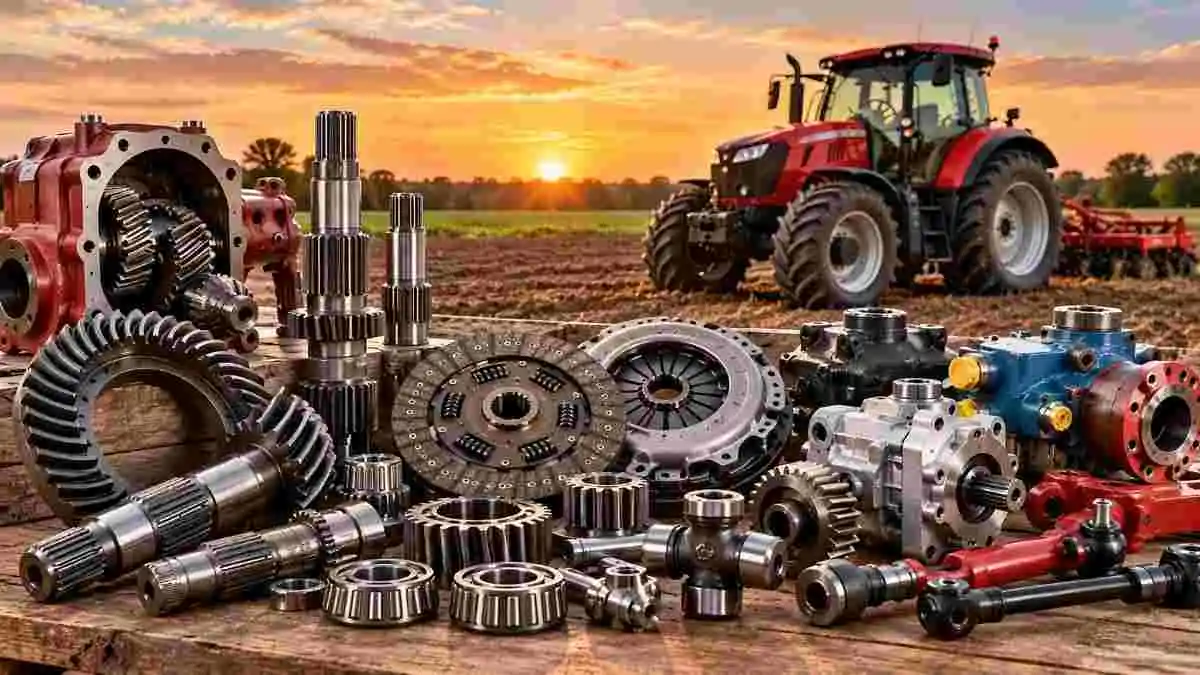
Each component is a part of a system, and understanding which one helps to quickly eliminate options. There are a handful of areas where most replacement needs are found: transmission, clutch and power take-off, hydraulics, axles and steering. When you organize your demands by system, you can properly describe the trouble and obtain the correct tractor components from a broad range of agricultural machinery spare parts. It also enables your supplier to react quicker. They're broken down in the next three sections.
Parts of the transmission have a lot of load since they are used to transfer the engine power to the wheels. Look at gears, shafts, synchronizer assemblies, bearings and planet gears. These are prominently featured on Blackbird Gears' list. When buying new tractor transmission parts, ensure that the tooth profile and shaft dimensions are correct. Any type of mismatch can lead to noise and uneven wear of tractor gears. Worn tooth surfaces or damaged splines can indicate it's time to replace them. If the gearbox needs repair, it is necessary to match.
The clutch, PTO and differential handle power delivery to implements and wheels. Items that are common include clutch plates, clutch shafts, PTO shafts and couplings, crown pinions, differential parts. Worn Tractor Clutch Parts result in poor pulling power and slipping. Implements like rotavators and balers will be impacted by faulty tractor PTO parts. Keep an eye out for slips or jerks in the engagement early on. Not just the appearance, match each piece of your model to its specification.
Hydraulic pumps and components lift and control implements. The weight of the tractor is borne by the axles, and the steering components determine its safe handling. When buying a tractor hydraulic part, verify the pressure and mounting information. When it comes to tractor axle parts and steering components, dimension and fit carefully. These systems are operated continuously and specifications are therefore more important than price. It's required for both front and rear axles.
Don't judge a book by its cover. Any two parts can be the same and have wildly different load behaviour. That is why it is necessary to look at tractor spare parts specifications properly.
Before the purchase, make sure to compare these points:
All of these have an impact on the position, rotation and wear of the part. Use a vernier caliper to measure the old part, if appropriate. Do not use vision to determine the distance. Precision tractor parts that are well made are accurate when under heavy load.
Both of them are at home in the workshop. Here is a fast comparison of the differences between genuine pieces and aftermarket parts on the key points of interest before purchasing.
| Factor | Genuine Parts | Aftermarket Parts |
|---|---|---|
| Source | Supplied or approved by the tractor brand | Made by independent manufacturers |
| Compatibility | Usually straightforward to match | Needs checking against model and part number |
| Cost | Often higher | Often lower |
| Availability | Can be limited for older models | Often easier to find for older models |
| Quality | Set by the brand's standards | Depends on the maker's process and quality control |
Both choices are not necessarily the best. Genuine tractor parts are provided by or approved by the tractor manufacturer and can be generally compatible with the tractor model. These can be expensive and difficult to find, particularly with older vehicles. Parts made outside of the original manufacturer are known as aftermarket tractor parts and are typically cheaper. But, in contrast, the quality is entirely dependent on the manufacturing process and quality control of the maker.
Your supplier is as important as the part. Reliable Tractor Spare Parts Suppliers ensure matching and reduce the chances of error. Prior to ordering, check the following:
Prior to committing to a tractor parts supplier in India, request their specifications and references. A supplier that is able to give a clear answer to technical questions will likely stand by the product. For instance, Blackbird Gears operates as a manufacturer, supplier and exporter of tractor spare parts. Also look at their returns and incorrect fits policies. Don't forget to inquire about packaging for secure travel, either!
Even the most seasoned home buyers make mistakes. Most tractor parts buying mistakes are easy to avoid once you know them.
Price is not much of an advantage if the part is not long-lasting. All of these are prevalent and fixable. A few extra minutes is all that's needed to make smart tractor spare parts selection. Those minutes are not as expensive as a repeat sale, or a tractor in the shed. They can be identified early and save time and money.
When a party surrenders, take a breather before ordering, next time. Look at your tractor's model. Match part number. Consider the size and parts, and the amount of work required. After that, locate one of the tractor spare parts suppliers who really answers your technical questions. If it takes a few more minutes now, the right tractor spare parts will be on the first time and your tractor will be back in the field where it belongs.
|
Looking for the perfect match? Check out Blackbird Gears' tractor spares and consult our staff today. |
Tractor spare parts identification starts with model, serial or reference number and dimensions. Compare these against manufacturer specifications or share them with your supplier before ordering.
Not always. Compatibility varies even within the same brand, since dimensions and spline counts can change. Always verify with the model and part number, and choose compatible tractor spare parts only after confirmation.
Share the tractor make and model, part number, dimensions, quantity and photographs or a sample where relevant. Complete details help with ordering tractor spare parts accurately and avoid costly returns.
Inspect material, machining accuracy, finishing and dimensions. Ask for hardness values and specifications, and check the supplier's quality controls. Consistent quality tractor spare parts show clean finishing and precise fitment.
Genuine parts come from the tractor brand or its approved sources. Aftermarket parts come from independent makers. Both differ in branding, sourcing and specifications, and quality depends on the manufacturer's standards.
Dealers should approach established manufacturers and suppliers with broad catalogues, part-matching support and bulk or export capability. A trusted Tractor Spare Parts Manufacturer can also keep supply consistent.